Modern Happy Hours: Social Media Posts That Actually Convert
Let's be honest: scrolling through social media feels like walking through a crowded marketplace where everyone is shouting. Your audience's thumb moves fast, and if your content doesn't stop them in their tracks, it's gone. You have about three seconds—maybe less—to make an impression. That's not a lot of room for error, and it's exactly why the visual foundation of your posts matters more than most people realize.
Whether you're a small business owner promoting a weekly special, a content creator building a lifestyle brand, or a marketer crafting campaigns for clients, the difference between a post that gets scrolled past and one that earns a save often comes down to design quality. Not just "pretty pictures" quality, but the kind of intentional, professional visual communication that signals credibility instantly.
What Makes a Great Social Media Template Worth Your Time
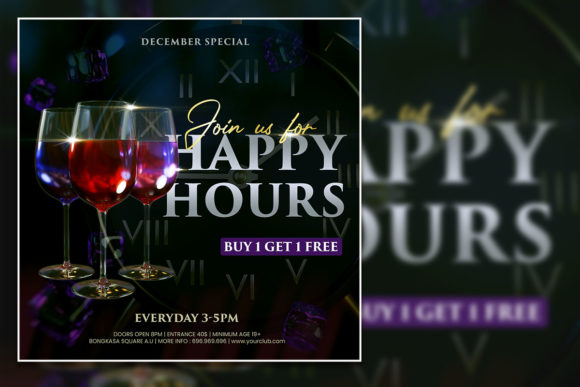
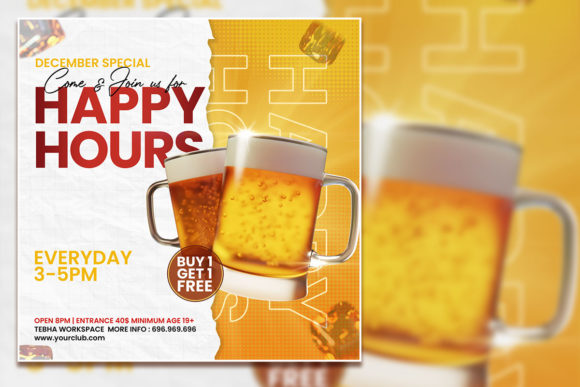
A well-designed social media post template isn't just a background with some text slapped on it. It's a strategic tool. The Modern Happy Hours Social Media Post template is built around this idea: give creators a polished, professional starting point that they can customize in minutes without needing advanced design skills.
At 2000 x 2000 pixels and 300 DPI in an RGB color profile, this template hits the sweet spot for both digital display and print-ready output. That means whether you're posting to Instagram, Facebook, Pinterest, or even printing flyers for a local event, the resolution holds up. No pixelation, no awkward cropping surprises, no "it looked fine on my screen" moments.
The file comes as a fully layered PSD, which is where the real power lives. Every element—text, shapes, color overlays, layout structure—sits on its own layer. You're not locked into someone else's creative vision. You can swap colors to match your brand palette, adjust text placement, resize elements, or completely restructure the composition. It's designed for people who want professional results without starting from scratch.
Why Layered Files Change Everything for Non-Designers
Here's something that separates a useful design asset from a frustrating one: editability. We've all downloaded a template that looked incredible in the preview, only to discover it's a flattened JPEG with no way to customize anything meaningful. That's not the case here.
The 100% layered structure means you can open this PSD file in Adobe Photoshop and immediately see how every piece fits together. Want to change the background color? There's a layer for that. Need to swap out the headline font? Select the text layer and type away. Looking to add your own photography or product shots? The template is structured so image replacement is straightforward—drag, drop, resize, done.
The free font inclusion is a practical touch that removes one more obstacle. You won't need to hunt down a specific typeface or worry about licensing fees for the base design. Install the font, open the file, and you're ready to customize.
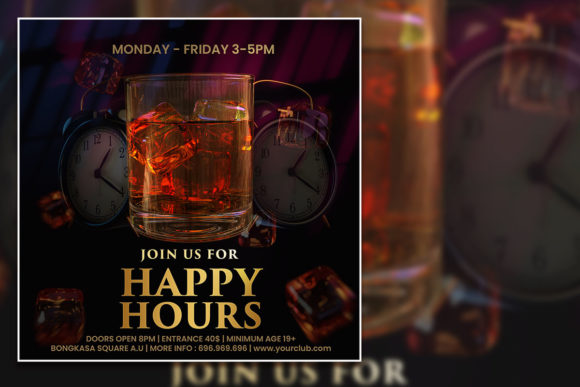
One important note: the preview images showing lifestyle shots, cocktails, or product photography are placeholders. They're there to help you visualize the final result, but you'll need to replace them with your own images. The good news? The file structure makes this genuinely simple, even if Photoshop isn't your daily tool.
Real-World Applications Beyond the Obvious
Social media graphics are the most immediate use case, but a versatile template like this extends far beyond a single Instagram post. Think about the full spectrum of touchpoints where a polished visual makes a difference.
Brand identity work: If you're developing a visual language for a new business, this template can serve as a starting point for exploring color schemes, typography hierarchies, and layout rhythms. Use it to prototype how your brand might look across different contexts before committing to a full style guide.
Event promotion: Happy hour specials, grand openings, seasonal sales, product launches, pop-up shops—any event that needs visual momentum benefits from a template that's already structured for impact. Customize the text, drop in your event details, and you have a shareable asset ready in under ten minutes.
Restaurant and bar marketing: Weekly specials, new menu items, cocktail features, happy hour announcements—these businesses live and die by consistent, attractive social content. A reusable template that can be updated each week without redesigning from zero saves hours over the course of a month.
Digital product creators: Selling Canva templates, social media bundles, or marketing kits? A high-quality PSD template can be reverse-engineered or adapted into your own product line. The layered structure gives you insight into professional composition techniques you can apply to your own designs.
Blog and website graphics: Featured images, sidebar banners, promotional graphics for lead magnets—all of these benefit from the same visual consistency that makes social posts effective. A cohesive look across platforms builds recognition faster than most people expect.
Print materials: Flyers, table tents, posters, menu inserts, invitation cards. At 300 DPI and a generous pixel dimension, the output quality is suitable for physical printing. This is where many digital-only templates fall short, so it's worth noting.
Matching Typography to the Mood You're Creating
Typography isn't just about readability—though that matters enormously. It's about emotional signaling. The fonts you choose tell your audience something about who you are before they read a single word.
A modern happy hour theme naturally calls for typefaces that feel contemporary, approachable, and slightly energetic. Think clean sans-serif fonts for body text paired with a stylish display font for headlines. The included free font in this template leans into that modern aesthetic, giving you a solid typographic foundation without additional purchases.
When you customize, consider these practical guidelines:
- Contrast is your friend. Pair a bold, attention-grabbing headline font with a simpler, more legible body font. This creates visual hierarchy and guides the viewer's eye through the content in the order you intend.
- Limit your typefaces. Two, maybe three fonts maximum per design. More than that creates visual noise and undermines the professional appearance you're building.
- Test at actual size. A font that looks stunning at 72 points on your monitor might become illegible at the size it appears on a phone screen. Always preview your design at the dimensions your audience will actually see.
- Consider your platform. Instagram compresses images differently than Facebook. Pinterest displays at different proportions. What works perfectly in one context might need adjustment for another.
Building Visual Consistency That People Recognize
One of the most underrated advantages of working with a reusable template system is consistency. When your audience sees the same visual language repeated—similar colors, typography, layout structure, and tone—they begin to recognize your content before they even see your name.
This isn't about being repetitive. It's about creating a visual signature. Think about the brands whose posts you recognize instantly in your feed. They've achieved this through disciplined, consistent visual communication. A template gives you the framework to do the same without requiring a design degree or a massive budget.
Start by customizing the template with your brand colors and preferred typography. Save that customized version as your new base. Each week or each campaign, you open that base file, swap out the imagery and text, and export. The underlying structure stays the same, but the content feels fresh. Over time, this rhythm becomes second nature, and your audience starts associating that visual style with your brand specifically.
A Few Honest Considerations Before You Download
No template is perfect for every situation, and it's worth knowing what you're working with. This file requires Adobe Photoshop to edit. If you're working exclusively in Canva, Figma, or another platform, you'll need to either convert the file or look for a compatible alternative. That said, for anyone with a Photoshop subscription—even the basic Photography plan—this format offers the most control and flexibility.
The commercial licensing angle matters too. If you're creating content for clients, selling finished designs, or using the template as part of a product you sell, make sure the usage rights align with your needs. Most template licenses allow for end-product use (like a social media post promoting your business) but may have restrictions on redistributing the template file itself. Read the terms before you commit.
Finally, remember that a template is a starting point, not a finished product. The most effective social media content reflects your brand's personality, your audience's preferences, and your specific message. Use the professional structure as a launchpad, then make it unmistakably yours.